Carrie: Re-visiting the Monstrous Mother 50 years later
By Jennifer L. Gauthier
Fifty years ago, on the night of November 3, filmgoers poured out of the Uptown Theater in Northwest Washington DC shocked and speechless. Brian DePalma’s Carrie grabbed audiences by the throat and didn’t let go, making over $3 million from sixty theatres in its first three weeks. A box office success by any measure (made on a budget of $1.8 million and eventually grossing more than $33 million), DePalma’s adaptation of Stephen King’s debut novel haunts us still. A 1999 sequel, a 2002 made-for-TV film, a 2013 re-make, a stage adaptation, and the most recent Amazon/MGM series exploit our fascination with the tragic teen who transforms from tormented to tormentor in a few short weeks.
Carrie White, played by a young Sissy Spacek, is freakishly familiar as the high school outcast and an easy target for the popular kids. She is our worst nightmare and her victimisation triggers the return of teenage repression in each of us. For who among us has not shuddered at the thought of sitting alone in the high school cafeteria? As girls, we shared the all-consuming fear of getting our periods in class, of looking stupid in front of the boy we liked. We see Carrie and we see ourselves in Carrie. When this puny protagonist summons her power, our own high school villains are vanquished. She turns out to be the meek but mighty girl of our dreams.
Enter Margaret White: the overbearing evangelical mother
But Carrie isn’t Carrie without her mother. When we first meet Margaret White (Piper Laurie), she is at the door of a neighbour’s house looking like the proverbial wicked witch. Clad in a black cape and carrying a basket, she could have stepped out of Snow White to offer the poison apple. The white and black dichotomy is surely intentional, as King’s novel sinks its teeth into the eternal battle between good and evil. Carrie’s mother oozes old-fashioned religious fanaticism, quoting the Bible, casting out demons, and ruling her daughter with an iron fist. When Carrie is “bad”, her mother drags her into a closet under the stairs, forcing her to kneel at an altar presided over by a creepy crucifix with glowing eyes. (It is not nearly as nice as Harry Potter’s cupboard under the stairs!)
Their White house is drenched in a neo-Gothic aesthetic: candles drip on every surface; the walls are hung with images of Christ and The Last Supper. DePalma’s set designer conjured up an interior dominated by three pointed archways, which echo the form of a religious triptych. Mother White’s fight to save her daughter’s besmirched soul is played out against a Biblical backdrop.
If you have seen any of the adaptations, or indeed, read the novel, you know that the making of Carrie is her menarche. Blood begins her battle with the baddies and blood also makes her bold. Though DePalma covers Carrie in copious amounts of claret, critics note that later versions of the story manifest even more muck.
It is this spectral substance that haunts the story, after all: Carrie’s menstrual magnificence enrages her mother. “After the blood come the boys, like sniffing dogs,” Margaret rages. Her daughter’s passage to womanhood reminds Mother of her own ghastly past with an abusive alcoholic who left her for another woman. Her shame, regret, and remorse rise up bitter as bile and she aims her venom at Carrie. She refuses her daughter’s request to go to the prom, tossing a drink at her as if throwing holy water on the devil.
The mother-daughter showdown
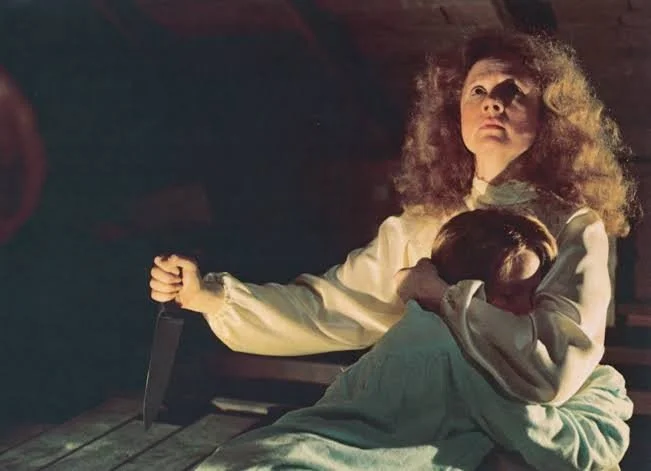
In the midst of her adolescent abjection, Carrie unearths the ability to control her surroundings. Mind over matter, or rather, menstrual over mousy, Carrie bends the world to her will through telekinesis. Discovering her deviance is empowering for Carrie and she wields her power against her mother. Margaret beats and belittles Carrie, and when brutalisation fails to subdue her daughter, she turns to murder. In the penultimate confrontation, Carrie returns home from the prom, fouled and forlorn. After washing off the blood and clad in a pristine powder blue robe, she seeks maternal comfort. As Carrie sobs into her mother’s bosom, Margaret kneels down before her daughter and confesses her sins: she wasn’t married to Ralph, who took her violently while drunk, and she “liked it.” The sin must be punished and Carrie is the living, breathing spirit of the sin, so mother stabs daughter.
DePalma’s Director of Photography films knife-wielding Margaret from below, descending the steps to loom over Carrie, who is curled up in a fetal position on the floor. She’s the bastard baby who must be banished. But Carrie’s survival instinct is strong and this deadly daughter sends sharp kitchen utensils flying through the air to pierce her mother’s palms and torso. Margaret is pinned against the central triptych frame like Christ on the cross. In her final moment, she rolls her head to the side to glare at her ominous offspring and the crucifixion is complete. What is DePalma suggesting here: martyr or monster? Margaret’s beastly behaviour has been punished and her daughter has dominated. But Carrie’s triumph is only temporary. In the final moments of the familial fracas, Carrie drags her mother into the castigation closet as the house disintegrates around them. The statue of crucified Christ glowers in judgment.
The villainy of sexual freedom
While it is easy to hate the tormenting teens who tease Carrie, Carrie’s mother is the real villain of the film. At the time of its release, in 1976, the film preyed upon growing backlash against the feminist movement and its embrace of new roles for women. Whether they were working outside the home, running for President, or (heaven forbid) getting their own credit cards, newly-liberated women of the 1970s threatened many Americans. Abnormal, unnatural, perverse, these women ran afoul of the patriarchy and its norms.
Though it is not clear that Margaret White has a profession, we do know that she’s a single mother who engaged in sex out of wedlock. Sexual freedom was particularly problematic for the rising tide of fundamental Christianity in America during the ‘70s. George Gallup and Time dubbed 1976 “The Year of the Evangelical”. The approval of the birth control pill in 1960, the 1965 ruling in Griswold v. Connecticut that made contraception legal for married couples, and the 1973 Roe v. Wade case declared war on tradition. The 1970s saw a rise in households with single mothers as well as an increased birth rate to unwed mothers. A single mother, Margaret White looms as a living rebuke to the established family unit. Carrie punishes her transgressions.
Monstrous mothers in the modern day
Here we are again, fifty years later, still punishing monstrous mothers. Today, it is the tradwife movement taking up the charge and it comes not through the big screen, but via the small. The social media hashtags #tradwife and #tradwives deliver content that celebrates traditional gender roles, specifically motherhood. Although the movement has haunted social media for several years now, its popularity exploded during the pandemic, when women who were stuck at home looked for ways to make their daily lives more interesting. Now, thanks to social media influencers on TikTok and Instagram, the trend has exploded. Model mothers like The Ballerina Farm’s Hannah Neeleman, Nara Smith, and Estee Williams romanticise the trappings of 1950s motherhood: they care for multiple children while cooking fabulous meals, keeping a dazzling home, and looking spectacular for hubby. Today’s tradwives make Ree Drummond look like Joan Crawford in Mommy Dearest.
The tradwife movement isn’t just made up of innocent posts about how much these women love their lives. No, the messages are prescriptive and often guilt-inducing. Tradwife Ivy Van Dusen explicitly recommends (in a high, breathy tone) “getting ready, putting on some makeup, putting on a cute outfit before you see your husband”. Or why not wear cute outfits all the time? The unofficial uniform of the tradwife influencer seems to be a frilly sundress, perfectly-styled hair, and full-face makeup, even for domestic tasks like preparing elaborate meals, cleaning the house, and chasing children.
Instagram’s Neeleman famously runs a farm in addition to a family. Her posts feature cows, sheep, tutus, and mud. Tradwife content promotes the joy, fulfillment, and near ecstasy that comes from being a mother and having a family. Nothing wrong with that, you might opine. But, in the process, these influencers demonise the feminist movement and the notion of female empowerment. They tell viewers that femininity is where the power lies, not success in a career. They shame mothers who put their children in child care so they can work outside the home. They wholeheartedly embrace strictly defined, traditional gender roles. One influencer counsels: “Obey your husband”.
Husbands, too, shape the discourse of traditional motherhood. In May 2024, Kansas City Chiefs’ kicker Harrison Butker delivered a Commencement speech at Benedictine College and his words reverberated beyond the podium. He took the opportunity to speak for his wife, noting that she “would be the first to say that her life truly started when she began living her vocation as a wife and as a mother”. He praised her for embracing “one of the most important titles of all: homemaker”. Butker’s comments take us back to a time when women were only valued for their procreative abilities and looked their best barefoot and pregnant. While the athlete faced criticism both within the NFL and in the general public, his critics today are more spooked by his kicking inaccuracy than his outdated opinions on motherhood.
Social media both reflects the culture and shapes it. Critics of the #tradwife movement observe that this content serves a conservative agenda; its creators are largely white, heterosexual, and often evangelical. Values communicated online echo offline and over the past several years we have seen women and mothers being punished IRL. The overturning of Roe v. Wade and other women’s health initiatives, the crippling of federal agencies like the EEOC that protect women in the workforce, and the slashing of SNAP funding for low-income (often single-mother) families damage women’s lives, whether they are mothers or not. We would do well to remember that, in the 1950s, women were not allowed to have their own bank accounts and were doomed to be dependent on the men in their lives (right where they wanted us.)
A shifting discourse?
Whether it is the small screen or the big screen waging war on mothers, the battle is brutal. And its impact is felt beyond the screen. Carrie is a symptom of its time. Masquerading as a garish girl-power extravaganza, it ambushes audiences with its anti-feminist agenda. While we can all take innocent pleasure in seeing Carrie wreak havoc upon the monstrous teens who bullied her, for some there is also the sadistic satisfaction of seeing her monstrous mother punished by a horrific death. Today the horror is dispersed across multiple social media platforms as women compare themselves to the mothers they see posting as #tradwife #tradwives.
But there’s hope yet. The success of Claire Caro Burke’s tradwife satire, Yesteryear has increased public discourse about the sinister social media trend; it has also raised awareness of the damage that the tradwife narrative can do. Some tradwife influencers have renounced the movement or distanced themselves from its evangelical strain.
Of course, it is never all smooth sailing for modern mothers. Now they must contend with the “evil-doppelgänger mommy” genre as well. Is this new mommy a better version of the old mommy? Or is this the monstrous mommy left unpunished? As pop culture continues to find ways to police motherhood, it is no wonder that birth rates in the U.S. are falling. Let’s take it easy on moms - theirs is a hard job and the future of our species depends on them.
Jennifer L. Gauthier is a film nut and college professor from Virginia who loves to introduce her students to classic films, especially if they feature a strong female lead.
Cover image: a promotional still from Brian De Palma’s 1976 horror, Carrie. Owned and licensed by Getty Images.