Private Lives Made Public: A sparkling spy-view behind closed doors
Two honeymooning couples in adjoining rooms… What could possibly go wrong?
The second episode of the Royal Exchange Theatre’s 50th anniversary celebrations, Private Lives presents a morally questionable depiction of the season’s ‘Homecoming’ theme. Throughout, it epitomises the cutting wit for which Noël Coward is renowned. Declarations of love meet satirical commentary on marriage. The most blissful moments descend rapidly into vitriolic chaos. Past coincides with present, and a metaphorical game of musical chairs between partners brings expectedly disastrous results.
Meet Amanda, played beautifully by Jill Halfpenny (who previously starred in A Taste of Honey). More than just a “leading lady”, Amanda is at once the object of her new husband’s unfiltered affections, the woman with whom her ex-husband’s new wife is obsessively fascinated, and one half of a volatile, passionate pairing with her not-so-ex husband Elyot. Halfpenny’s performance is wonderfully chic, witty, and genuinely fabulous. It’s easy to see how everyone falls in love with her!
It certainly helps that Coward affords several of his sharpest aphorisms to Amanda. You can be certain that the Harpy audience silently squealed at this particular gem:
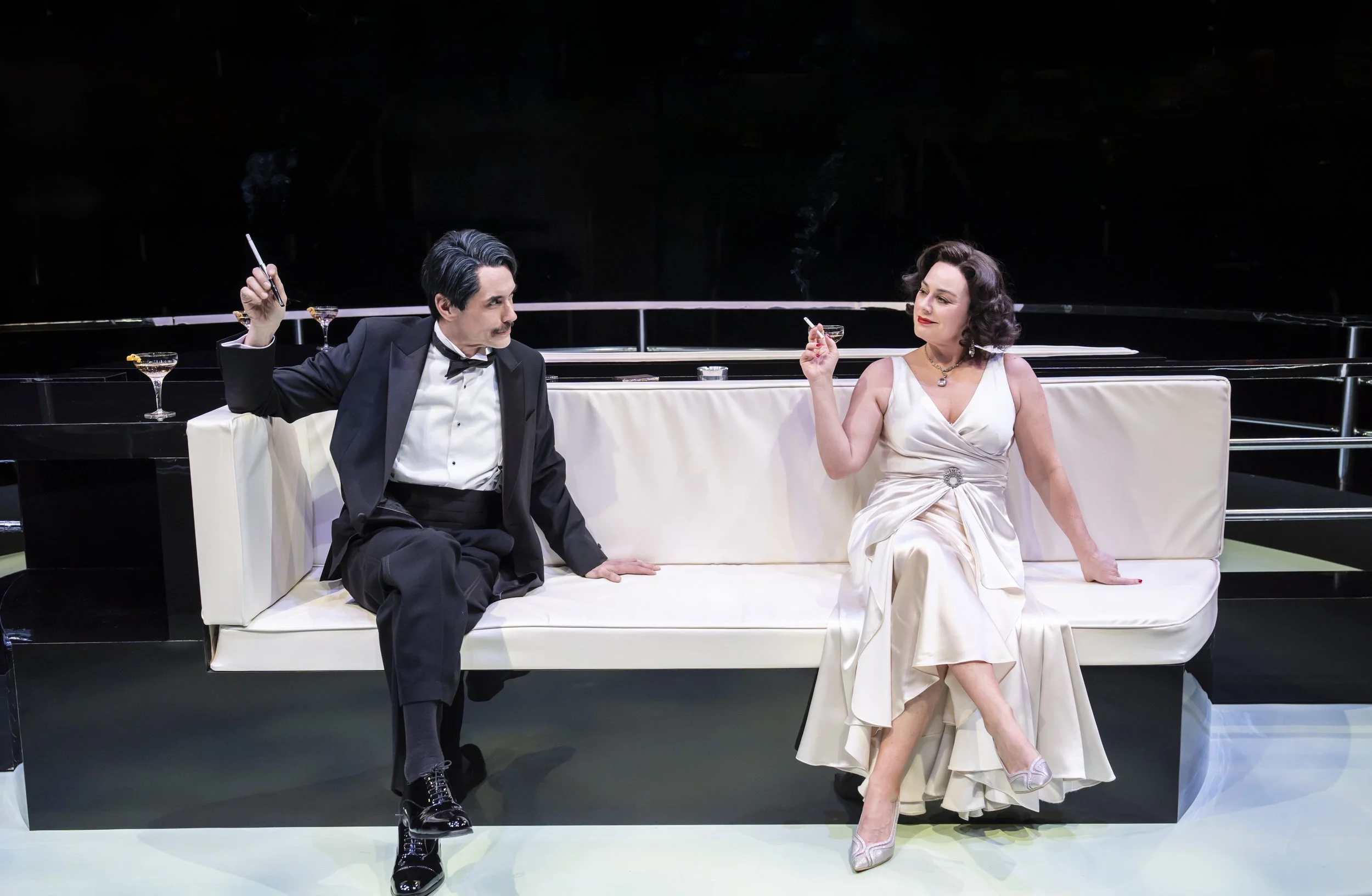
Sparring with a smile: Steve John Shepherd and Jill Halfpenny
Elyot: "It doesn't suit women to be promiscuous."
Amanda: "It doesn't suit men for women to be promiscuous."
Whilst Halfpenny’s Amanda is the magnetic heart of the show, Steve John Shepherd is laugh-out-loud funny as Elyot. His sardonic tone fills the entirety of his frame, with eye-rolls that can be felt in the upper balconies. Shepherd takes Coward’s wit and wraps it in layer upon layer of tart bitterness. His timing, often unexpected pauses, and carefully-placed intonation continually catch the audience off guard to thrilling effect.
Without doubt, some of the production’s most hilarious moments require absolutely no lines from Coward at all. Amanda and Elyot’s truce-making silences - that last seemingly forever - relish in the beauty of mime-based humour. It’s in moments like these that Blanche McIntyre’s direction injects wonder into the gaps between the written words.
Halfpenny and Shepherd must navigate from witty sparring to overt displays of affection, onto full-out war and back again, all at a pace of knots. Whilst a couple of snippets are a little too farcical for my taste, the heightened emotions are entirely justified by the need to escalate so quickly. The spinning stage behaves wonderfully as a guide through these emotional rollercoasters, adjusting speed in line with atmospheric changes.

Marvellous melodrama: Jill Halfpenny as Amanda
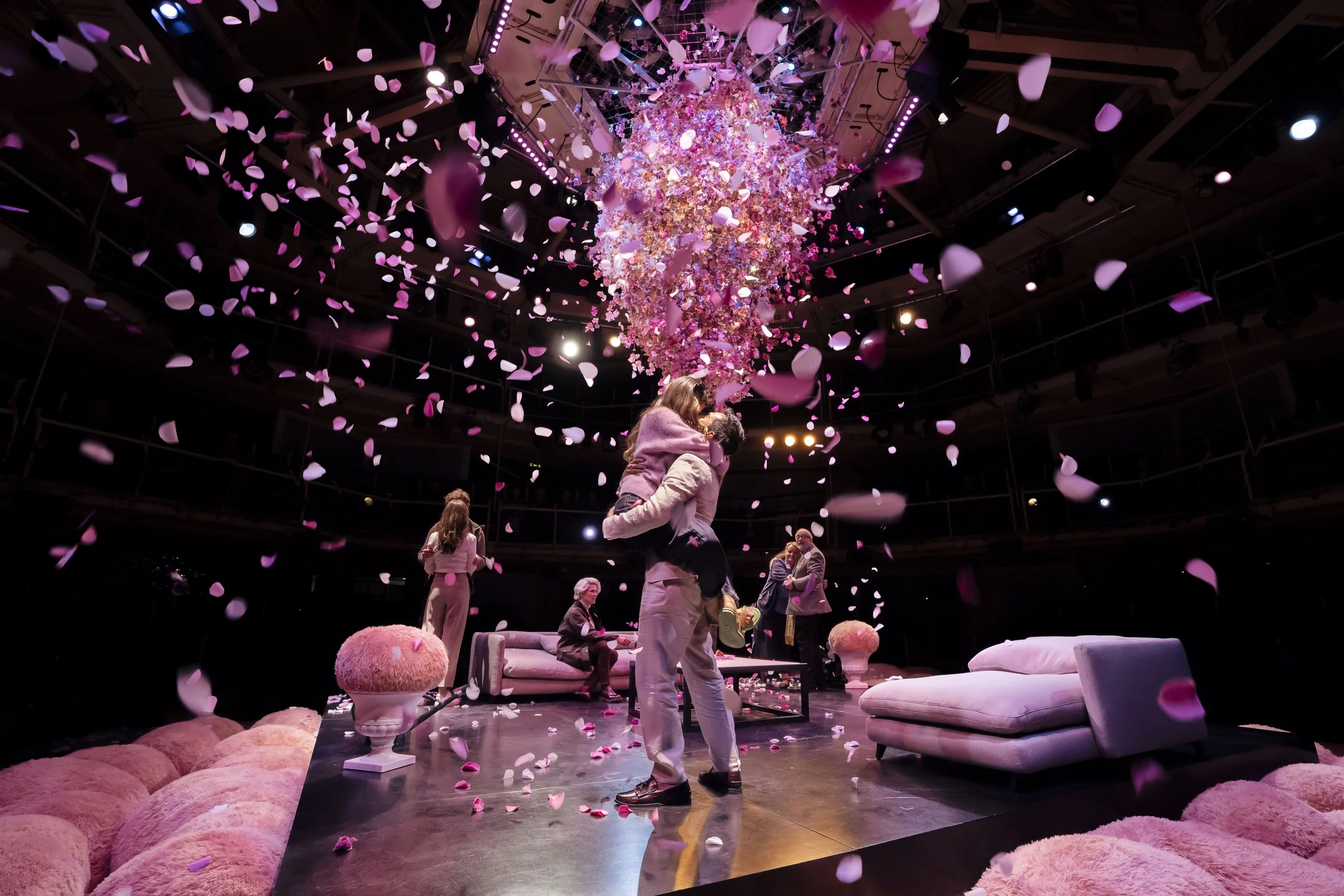
The central act does escalate into quite genuine darkness at times. Upon re-entry from the interval, the set design is almost jarringly altered and points to a new era for the relationships we’ve only just begun to scratch the surface of. McIntyre’s direction seems to encourage the cast to create moments of true discomfort that clash with the flippancy and frivolity that abound elsewhere. As Selina Cartmell (Artistic Director and Co-CEO at the Exchange) puts it: this particular selection from Coward’s repertoire offers “sparkling dialogue seamlessly interwoven with the dark underbelly of our rebellious heart’s desire of love and obsession”.
Thankfully, we can count on Sibyl and Victor to buffer some of the more dramatic interludes. Whilst Amanda and Elyot dominate the central narrative (and central act entirely), their respective spouses serve a more light-hearted role as mirrors to the central drama.
As Elyot’s tortured new wife Sibyl, Shazia Nicholls is challenged to craft the role of a victim who we’re not really supposed to give two figs about! Nicholls shapes a superbly shrill caricature, whose civilised facade slips as her eyes burn and nostrils flare with comical fury.

A sinister turn with Steve John Shepherd
Alongside, Daniel Millar’s Victor is the loveable, pitiable “good guy who comes last”. His physicality brings huge comedic value, from limp-wristed fisticuffs to the dejected bowed head of a man who simply doesn’t have it in him to be ungentlemanly. The audience can’t help but celebrate when he finally reaches boiling point and his opportunity to explode!
From the moment we step into the theatre module, Private Lives transports us back to the 1930s. Dick Bird’s design for act one is crisp and chic. It feels unusual to watch Coward staged in the round, but the back-to-back balconies invite some fabulously exaggerated reclining poses to enable views from all sides.
This production at once seems to revel in nostalgia and also to highlight the universal relevance of our underlying human nature. Gendered power struggles, social expectations, and a proclivity for slipping into jealousy all feel unavoidably familiar. The beauty of this play is how it offers up those biting observations in the frame of a genuinely enjoyable - at times even hysterical - and overwhelmingly positive evening at the theatre.
Private Lives plays at Manchester’s Royal Exchange Theatre until 2nd May 2026. For tickets and more information, visit the Royal Exchange website.
Or explore our archive of theatrical reviews to glean a taste of what’s to come.
Production images by Johan Persson.